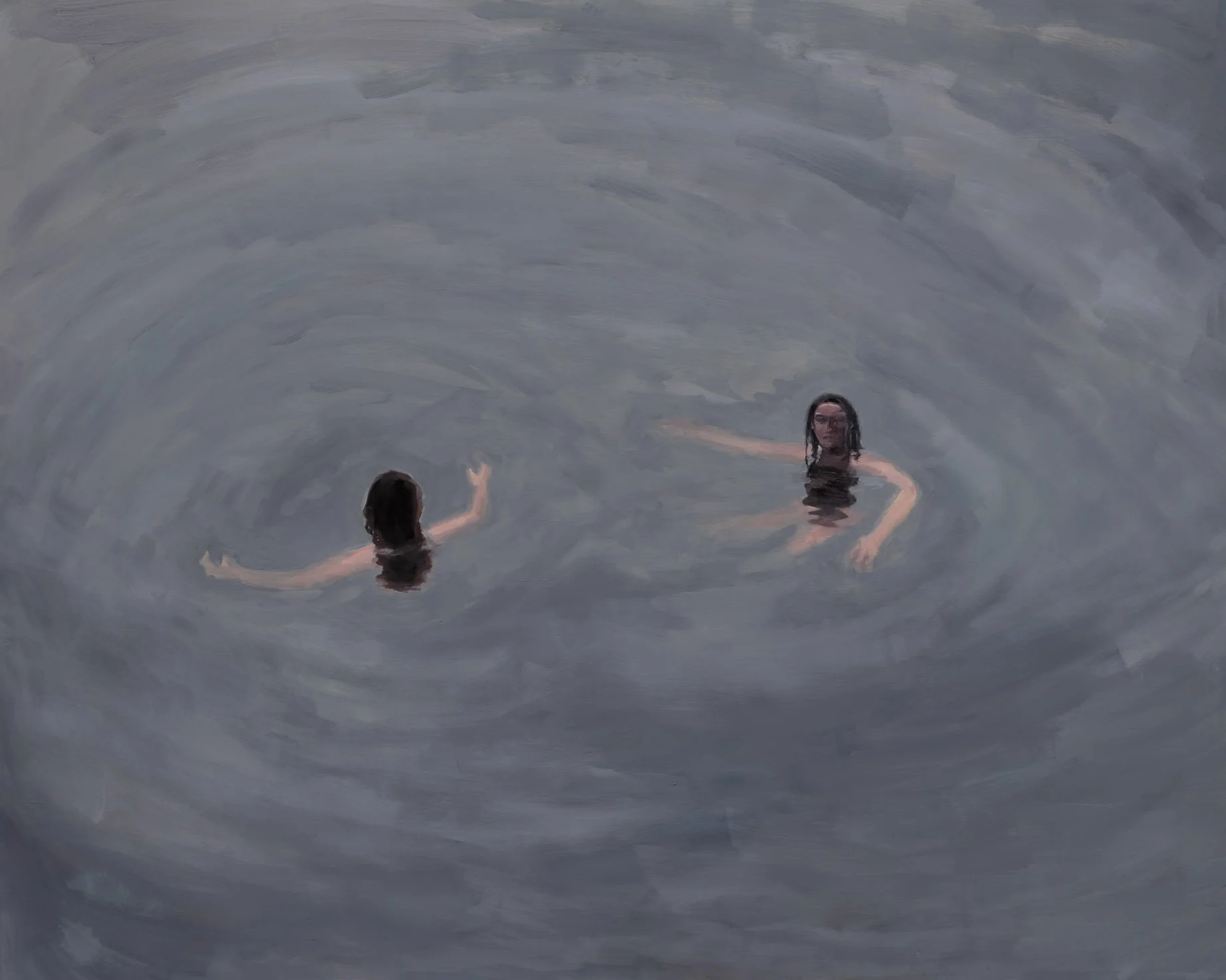
The title “Everything we broke today needed breaking anyway” harnesses the mood of Nancy Friedland’s paintings, a series that catches and reveals the rhythms of a family in motion. The words are lyrics from a plaintive song by folk ensemble This is the Kit. As the scaffolding of Friedland’s achingly intimate studies, they bring to mind a nursery rhyme murmured in a baby’s ear, or an incantation a teenager repeats to herself, eyes closed, after a bad family dinner ends in smashed dishes. In a family, as in life, the breaking is inevitable and the mending is imperative, and so these are the right words to accompany us into the generous world of the artist.
It’s a specific place. Friedland, who began her career as a photographer, works from her own photographs of her family. The setting is her parents’ lakeside cottage in northern Ontario, Canada. In the anchor painting of the house at night, the outside darkness is kept at bay by the inside fire, and a puddle of light outside the front door is an invitation. Come in. Right here, in this place, time will pass, people will come and go. And yet, taking in the paintings as a group, the specificity gives way to a generalized summer feeling: this is Friedland’s world but also a holiday of the imagination. These people, dependent and interdependent, are familiar to anyone ever caught in the sticky web of family dynamics. I am reaching for you across the bed in the lamplight. I am escaping all of you by jumping in this lake, holding my breath under water (but offering a thumbs-up, so don’t worry).
Placed next to one another, the paintings almost function like the frames of a film, pushing a story along. In the first light, a little outboard motor boat moves across the water’s unbroken surface. Two figures in the boat are cradled in the centre of the painting by the pinkening sky above, a reflective slab below. Perhaps something profound is being passed between generations—or did I bring that story? Is fishing at dawn such an archetypal snapshot that I’ve imposed my own meaning? The artist doesn’t say, and the paintings only tease, flicking at our commonality, providing less information than Friedland’s previous work. Even the brush strokes are thicker, less descriptive; the palate simplified to greeny greys, blues and pinks. The effect is a kind of suppleness that shows the way memory can be both vivid and faint at once. Friedland is giving her subjects more space now: a child’s bare back in the sunlight, strong but vulnerable, fills almost the entire field of vision. The viewer is trusted to fill in the details and bring her own fellow feeling to this summer day.
When family is the subject, the danger for any artist is the phoniness of nostalgia. Consider the word “anemoia”: a yearning for something that never existed. Yet Friedland’s paintings –beautifully shaggy– are a bulwark against the idealised family portrait. Where there is love, there is also tension. A young man sets himself apart, sneaks outside for a nighttime smoke, inhaling angrily. A sad daughter’s face takes up the canvas. She casts her eyes down, rests her head on her folded hands, chin pressing against the letters of her friendship bracelet. The plastic bracelet is sweet and dissonant; a child’s object on a young woman’s body. You can almost hear the retort right after the invasive camera clicks: “Mom, don’t.” A portrait of growing up, and away.
Because in a family, someone is always leaving. On a field of grass, a boy curls up with his beloved dog. For children, pets are lessons in mortality, practice for the unavoidable losses ahead. On the sun-dappled grass where they lie together, light advances and retreats. Friedland’s characters are caught often in the penumbra, a place of partial illumination. The ones we love, as they grow and age, are moving perpetually between light and dark. On Friedland’s family island, the ordinary world of the living contains the shadows of the next one. Her paintings are a rebuke to the way time goes. Each image stops right between this fleeting moment and the next, and fixes us there to wonder and revel in the air and light. But just because a scene –or a person– is familiar doesn’t mean it’s known. And so Friedland nudges us to look again, at her tender paintings and the ones we love, in the hopes we may get close enough to see.
Katrina Onstad
March 2025


